
Think You Have Bedbugs? Here’s What to Do and What Not to Do
If you’re in Northampton or Northamptonshire and you’ve spotted something suspicious in your bedroom, you’re not alone. Bedbug cases have been rising steadily across the UK and the East Midlands is no exception. Before you do anything, read this. Some of the most common first reactions to finding bedbugs actually make the problem significantly worse.
First, make sure it actually is bedbugs
Before doing anything, confirm what you’re dealing with. Bedbugs are regularly confused with other insects. Look for these signs:
- Small dark spots on mattress seams and bed frame joints, bedbug droppings
- Rust coloured stains on bedding from crushed bugs or blood spots after feeding
- Shed skins, translucent hollow shells found in seams and joints
- Live bugs, oval shaped, reddish brown, about 5mm. Juveniles are smaller and almost see through when unfed
- Bites in clusters on exposed skin, though bites alone aren’t reliable confirmation as reactions vary hugely between people
Use a torch and check mattress seams, bed frame joints, behind headboards and skirting boards.
What NOT to do
This is where most people go wrong.
Don’t use over the counter sprays
Most supermarket and DIY store bedbug products contain pyrethrins or similar compounds that act as flushing agents. These don’t just kill, they irritate and disperse. Bugs that would otherwise stay in one harbourage scatter through the property, moving into walls, adjacent rooms and furniture that was previously unaffected. You may kill a small number but drive the rest deeper and wider through the building. In most cases over the counter spraying makes the problem significantly harder and more expensive to resolve.
There’s another important reason these products underperform. Insecticides don’t penetrate bedbug eggs. The egg shell is highly resilient to chemical treatment, even professional insecticides don’t reliably kill eggs. This is why a proper treatment programme requires a minimum of two visits spaced roughly two weeks apart, with the second visit targeting nymphs that have hatched since the first treatment. An over the counter spray has even less chance of breaking the cycle.
Don’t move your mattress or furniture through the house
It feels logical to move an infested mattress out or shift furniture away from the affected area. Don’t. Bedbugs exhibit thigmotaxis, meaning they instinctively seek out tight spaces where surfaces press against them on multiple sides. They will be tucked into every seam, fold, joint and crack throughout an infested item, not just visible on the surface. Carrying an infested mattress through your home deposits bugs and eggs in every room you pass through.
Don’t throw furniture out straight away
Throwing a mattress or bed frame out before treatment rarely solves anything. Bedbugs live throughout the room, in skirting boards, under carpets, behind wallpaper. A new mattress into an untreated room will be reinfested within days. It’s expensive, unnecessary and spreads the problem further when the item is carried through the house.
Don’t assume they’ll stay put
Bedbugs are largely passive. As long as they have a host to feed on nearby they have little reason to move far. But they are capable of travelling in search of a host when needed, moving through walls, flooring and pipe runs in multi occupancy buildings. Don’t assume an infestation will stay confined to one room or one property indefinitely.
What you CAN do yourself
There are some genuinely useful steps you can take that won’t make the situation worse.
Hoover thoroughly
Hoovering mattress seams, bed frame joints, skirting boards and carpet edges removes bugs, eggs and shed skins. Use a crevice tool and work slowly. When you’re done, immediately remove the hoover bag, seal it inside two plastic bags and put it straight in the outside bin. Don’t leave it inside the house. If you have a bagless hoover, take it outside first and empty it directly into a double sealed bag, never into an indoor bin.
Bag and wash clothing and bedding correctly
Don’t carry armfuls of bedding and clothing through the house. You’ll deposit bugs along the way. Bag everything in sealed plastic bags first, carry the sealed bags to the machine and empty them directly into the drum. Wash at 60 degrees minimum. Tumble dry on high heat afterwards for extra protection.
A note on the science.
All bedbug life stages die at sustained exposure to 54.8 degrees Celsius. Eggs are the most resilient stage and require longer exposure at that temperature to be reliably killed. A domestic washing machine at 60 degrees with a full cycle provides enough sustained heat to be effective. A quick wash at 40 degrees does not.
Freeze items you can’t wash
Items that can’t go in the wash, shoes, bags, soft toys, books, can be treated by sealing them in plastic bags and placing them in a freezer at -18 degrees or below for a minimum of four days. This matters because bedbugs are surprisingly cold tolerant. Brief exposure to cold alone is not enough. The four day duration at -18 degrees or below is what makes freezing reliable.
Reduce clutter and bag it properly
Clutter is a bedbug’s best friend. Because of thigmotaxis, bedbugs actively seek out tight confined spaces where they can press against a surface on multiple sides. The spine of a book, a folded carrier bag, a pile of clothes on the floor, all of these provide ideal harbourage. More clutter means more hiding places, more places to breed, avoid detection and survive treatment.
Reducing clutter around the bed and sleeping area limits where they can harbour and makes any treatment significantly more effective. When bagging clutter to remove it, double bag everything and seal it tightly. Bedbugs will travel in search of a host if disturbed and an unsealed bag carried through the house is just another way to spread them further.
A note on resistance
Bedbug resistance to insecticides, particularly pyrethroids, is well documented and increasingly common across the UK including here in Northamptonshire. This is one of the reasons over the counter products are so unreliable and why professional treatment uses a combination of methods rather than insecticide alone. If you have already tried chemical treatments and activity has continued, resistance may be a factor worth discussing with a specialist.
When to call a professional
Some very early, contained infestations can be managed with the measures above if carried out thoroughly and consistently. But be honest with yourself about whether it’s working.
Consider professional treatment if:
- Signs are present in more than one area or room
- You’ve followed the above and activity is continuing after a few weeks
- The property is heavily cluttered or has lots of potential harbourage
- You’re in a flat, HMO or terraced house where bugs can travel between properties
- You simply don’t have the time or means to tackle it properly yourself
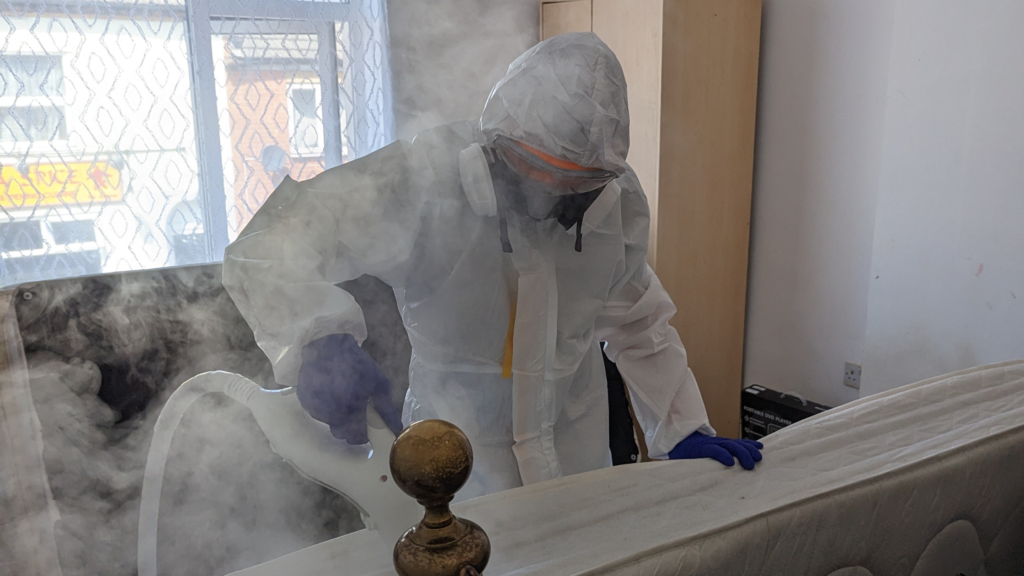
Professional treatment combines steam and insecticide in a targeted two stage programme, addressing active bugs in the first visit and newly hatched nymphs in the second. It’s not just about what products are used, it’s about knowing where to apply them and how to avoid making things worse. You can read more about how we work on our treatment page.
Not sure what you’re dealing with?
If you’re not certain whether what you’re seeing is bedbugs, don’t worry. Send us a photo through our contact form or drop us a message on WhatsApp and we’ll take a look. No obligation, no sales pitch, just an honest answer. We’re happy to help you figure out what you’re dealing with before you decide on any next steps.
Based in Northampton, covering the wider area
BedBugs2Go is a specialist bedbug service based in Northampton. We cover a wide area across Northamptonshire and beyond. Use the postcode checker on our contact page to see if we cover your location. Same day response available.