
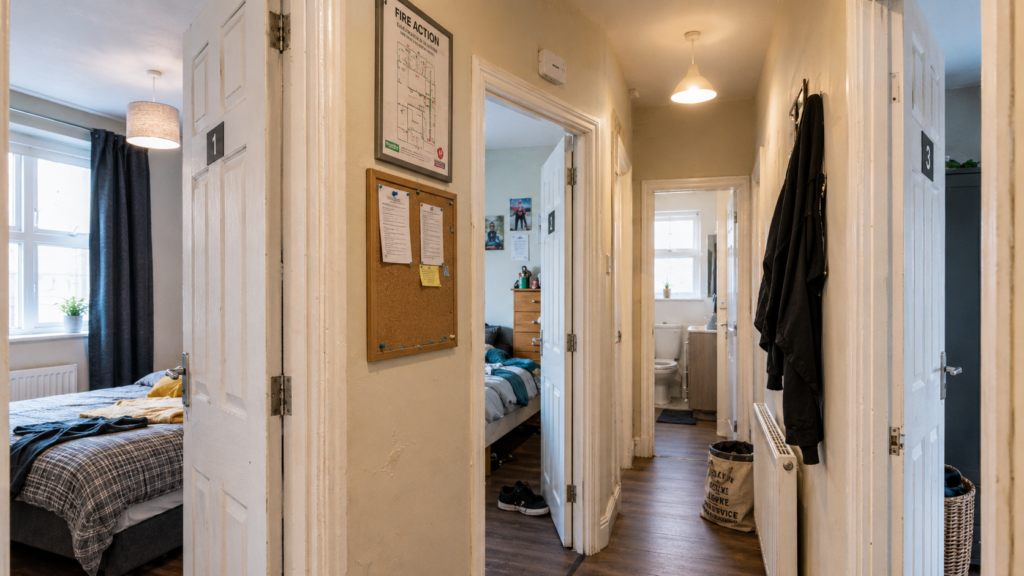
If you manage or let an HMO, bedbugs are one of the trickiest pest problems you’ll deal with. Not because they’re hard to identify — they’re not. It’s because figuring out who’s responsible, and who pays, is rarely straightforward.
This guide is for landlords and letting agents who want a clear, practical answer: what UK law actually says about bedbug responsibility, why HMOs carry more risk than single-let properties, and exactly what to do when a tenant reports an infestation.
Why HMOs are higher risk for bedbugs
Bedbugs don’t care about housekeeping. They travel in luggage, clothing, second-hand furniture and on visitors — and once they’re in a building, shared walls, corridors and communal areas make it easy for them to move between rooms.
In a single-let property, an infestation usually stays contained to one household. In an HMO, it can spread between tenants who’ve never even met, simply because they share a landing or a laundry room. That’s what makes early action so important: a bedbug problem in one room of an HMO is a building-wide risk, not just one tenant’s personal problem.
Is the landlord responsible for bedbugs in an HMO?
There’s no piece of legislation in England that mentions bedbugs by name. Instead, several different laws combine to set out where responsibility usually falls.
The Landlord and Tenant Act 1985 (Section 11) requires landlords to keep the structure and exterior of a property in good repair. If bedbugs are getting in or spreading because of disrepair — damaged skirting boards, gaps around pipework, that kind of thing — that’s a landlord repairing obligation.
The Homes (Fitness for Human Habitation) Act 2018 means a property has to be fit to live in throughout the tenancy, not just at the start. A serious, unaddressed infestation can make a property unfit, regardless of who originally caused it.
The Housing Act 2004, through the Housing Health and Safety Rating System (HHSRS), gives local councils the power to assess pest infestations as a hazard. If a council inspector rates an infestation as a Category 1 hazard, they can legally require the landlord to act — and in serious cases, can prohibit part or all of the property from being occupied until the hazard is resolved.
HMO licensing conditions add another layer. If your property needs a mandatory HMO licence — generally five or more people from two or more households sharing facilities — your licence conditions will typically require you to keep the property safe and well-managed. Operating an unlicensed HMO, or breaching licence conditions, can result in a civil penalty of up to £40,000 (raised from £30,000 under the Renters’ Rights Act 2025), alongside other enforcement action.
This matters more than usual if you let in Northampton. West Northamptonshire Council runs its own Additional Licensing scheme on top of the national rules. Since February 2025, this covers HMOs with just three or four occupants from two or more households — well below the national five-person mandatory threshold — across designated areas of Northampton and Daventry. If your property falls into that smaller category, you may need a licence locally even though it wouldn’t require one nationally. It’s worth checking your address against the council’s designated areas directly rather than assuming the national threshold is the full picture.
None of this hands you a simple rulebook that says “landlord pays” or “tenant pays” in every case. What it does mean is that landlords carry a clear, ongoing duty to respond properly once they know about a problem — and that ignoring a report is the one approach guaranteed to make things legally and financially worse.
So who actually pays for bedbug treatment in an HMO?
In practice, responsibility tends to come down to two things: when the infestation started, and what caused it.
If bedbugs were already present when a tenant moved in, that’s generally a landlord issue. If an infestation develops well into a tenancy with no clear external cause, it’s harder to say definitively — though it’s worth knowing that bedbugs can go unnoticed for some time even in a clean, well-kept room, so “it appeared after they moved in” doesn’t automatically mean a tenant brought it in.
In an HMO specifically, there’s an added wrinkle: even if one tenant’s room was the original source, the landlord is usually still responsible for treating the wider spread, because the shared structure and communal areas are the landlord’s responsibility regardless of how the infestation started.
This is exactly why a professional inspection matters. An experienced technician can often give an informed estimate of roughly how long an infestation has been established, based on the number of life stages present (eggs, nymphs, adults) and the extent of activity. That doesn’t give you a precise date, but it gives you real evidence — far more useful in any dispute than guesswork from either side.
What to do when a tenant reports bedbugs
Don’t wait and see. Bedbugs don’t resolve on their own, and a delay of even a few weeks can take a one-room problem into a building-wide one — particularly in an HMO with shared walls and communal spaces.
Get a professional inspection booked promptly. This protects you in two ways: it starts dealing with the actual problem, and it creates a documented, dated record of what was found and when. That record matters if questions about responsibility or cost come up later.
Communicate with all affected tenants, not just the one who reported it. In an HMO, that may mean inspecting adjoining rooms even if no one else has said anything yet. Bedbugs are good at staying hidden until numbers build up.
Don’t try to manage it with over-the-counter sprays as a way of avoiding a proper inspection. Partial treatment is one of the most common reasons infestations come back worse — it can scatter bedbugs into neighbouring rooms rather than eliminate them, which is the last thing you want in a shared building.
Keep records. Dates of reports, inspection findings, treatment dates, and any communication with tenants. If a dispute over cost or responsibility ever escalates — to a council, a tribunal, or otherwise — this paperwork is what supports your position.
The bottom line
There’s no single rule that decides who’s responsible for bedbugs in an HMO. But there is a clear standard for how landlords are expected to respond: promptly, properly, and with proper evidence to back up whatever decisions follow. Get a qualified inspection early, treat the building as a whole rather than room by room, and keep a paper trail. It won’t make the legal question simple, but it will put you in a far stronger position whatever the answer turns out to be.
Related reading:
- Think You Have Bedbugs? Here’s What to Do and What Not to Do
- Bedbug Treatment in Northampton — What to Expect and How to Choose a Specialist
This article is for general guidance and isn’t a substitute for legal advice. If you’re dealing with a specific dispute over responsibility or cost, it’s worth speaking to your local council’s environmental health team or a housing solicitor.