
You’ve found a small, flat, reddish-brown insect near your bed. Your first thought is the obvious one: bedbug. And you might be right. But you might not be.
In the UK, “bedbug” almost always means one species. What surprises most people, and quite a few pest controllers, is that it has several close relatives that look almost identical to the naked eye. Some of them turn up in homes. And telling them apart matters, because the insect you’re dealing with decides how you get rid of it.
Here’s what’s really out there, and why it’s worth knowing the difference.
They’re all part of the same family
Bedbugs and their lookalikes belong to a single insect family called Cimicidae. These are “true bugs”, part of the order Hemiptera, and they all share one habit: they feed on the blood of warm-blooded animals.
That shared diet is why they look so alike. Millions of years of living the same way has given them the same basic body plan: flat, oval, wingless, and about the size of an apple seed when fully grown. Flat bodies let them squeeze into the thinnest cracks. A blood meal is the only thing on the menu.
What separates the members of the family is not so much how they look, but who they feed on and where they live. That’s the key to the whole thing.
The one that lives with us: the common bedbug
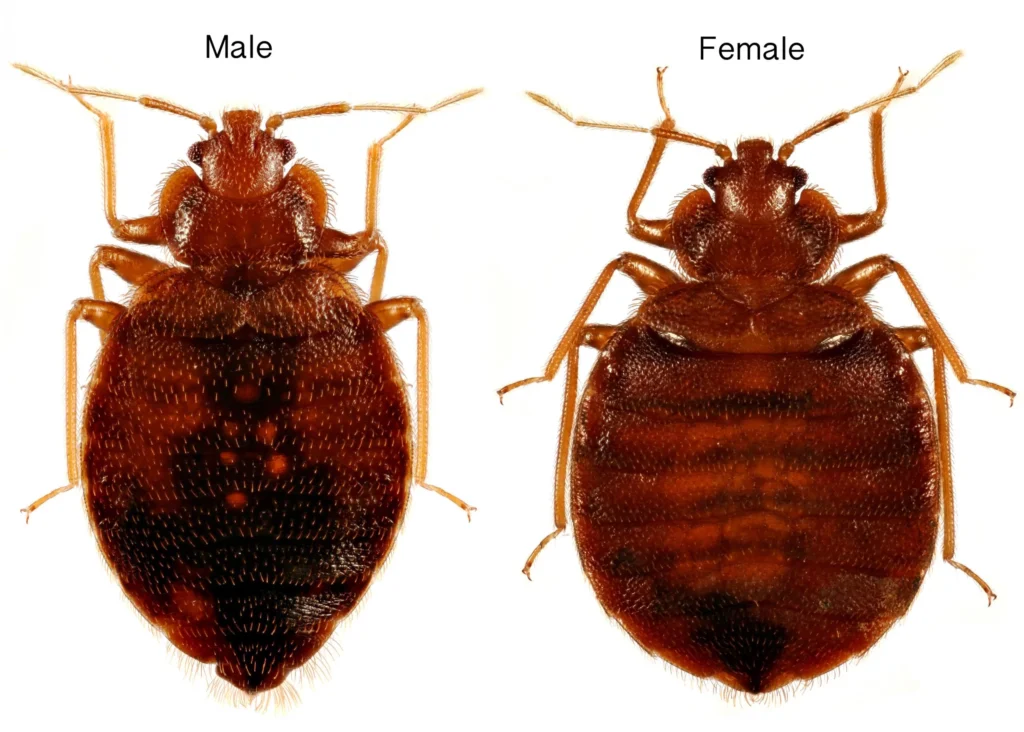
The species behind nearly every UK infestation is the common bedbug, Cimex lectularius (Figure 1).
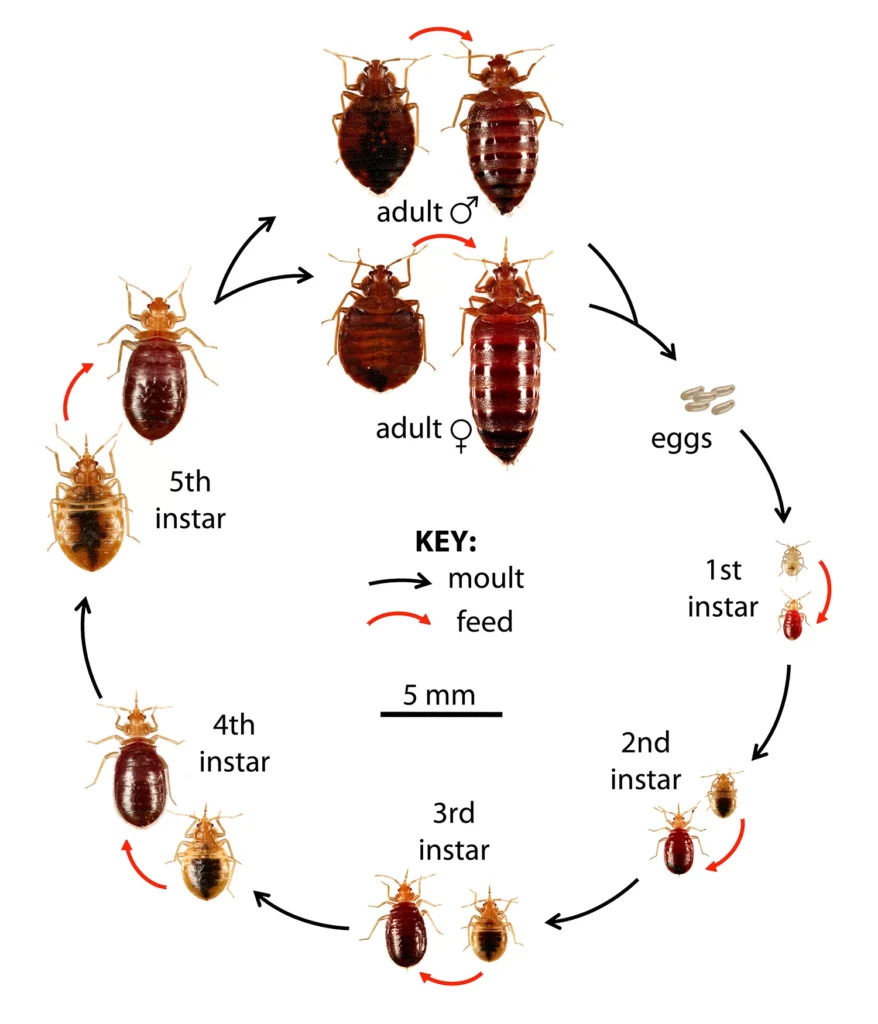
An adult is around 4 to 5mm long, apple-seed sized, flat, and rusty brown. After a feed it swells and darkens to a deeper red. The young, called nymphs, hatch pale and almost see-through, and get bigger and darker each time they feed and moult. There are five nymph stages before adulthood, and the eggs are tiny, pale and about the size of a pinhead. You can follow the whole cycle, from egg to adult, in Figure 2.
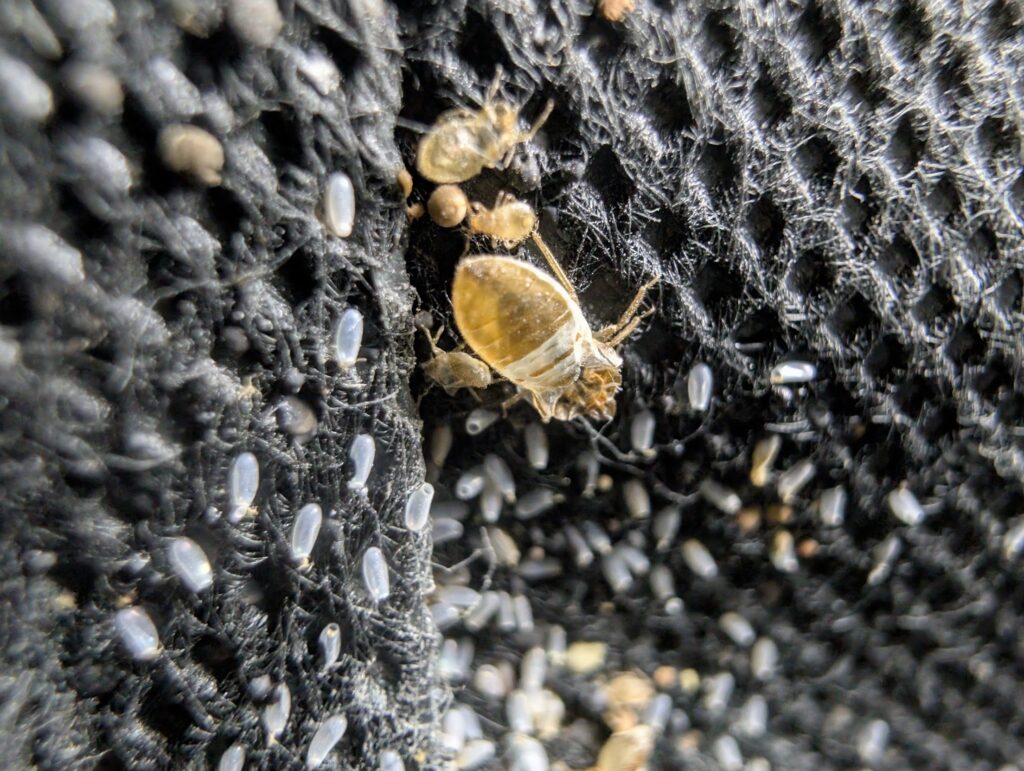
The eggs are a useful sign in their own right. Each one is pearly white and about 1mm long, and the female cements them in place, usually in clusters tucked into a seam or crevice (Figure 3). Because they are glued down and grouped together, they are much harder to mistake for random debris than a single loose speck would be.
This is the one that has adapted to live alongside people. It hides in mattress seams, bed frames, headboards, skirting boards and behind loose wallpaper, and it feeds on us at night.
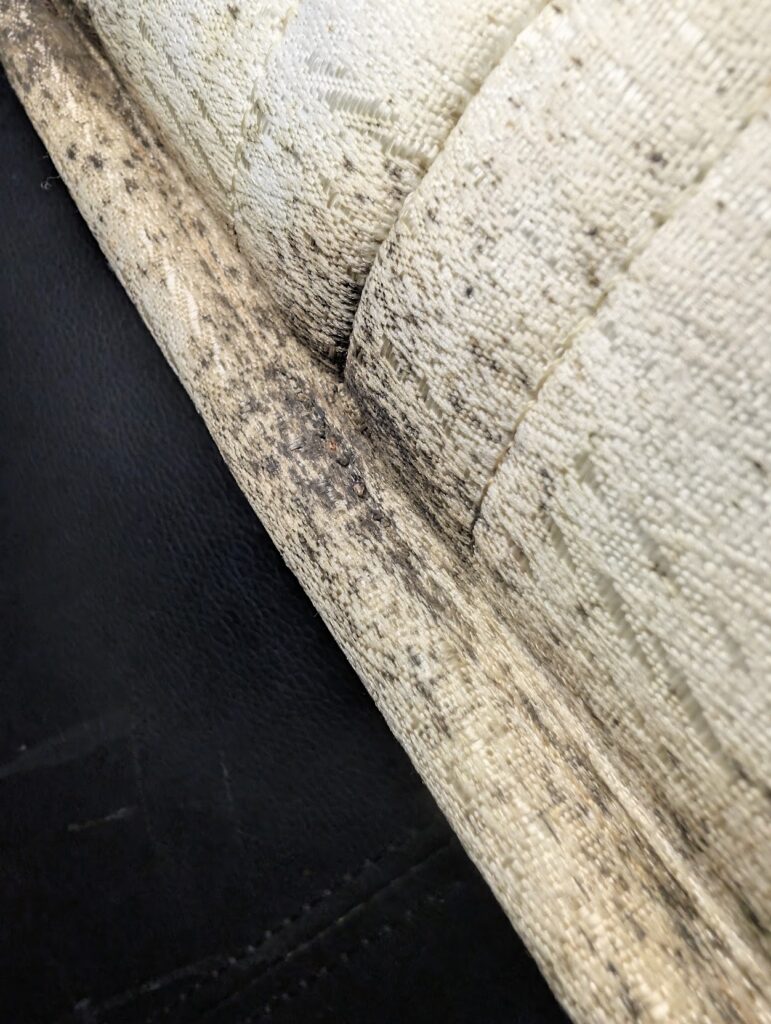
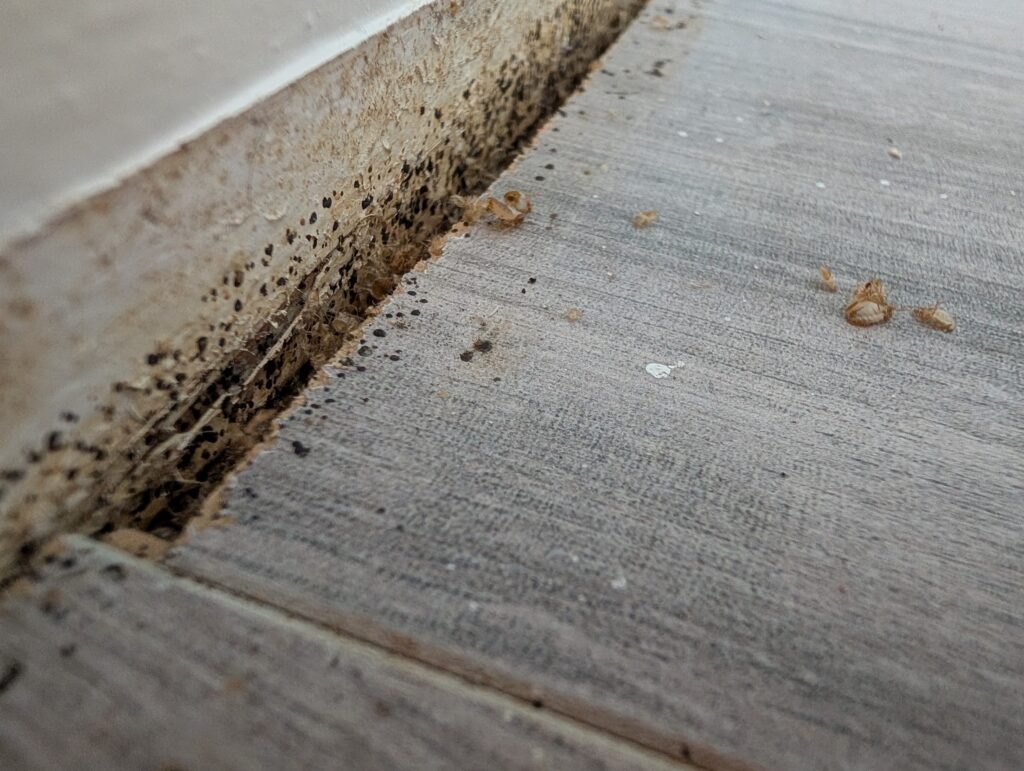
Often the easier thing to spot is not the bug itself but the mess it leaves behind. Look for dark faecal spotting, small blood smears on the sheets, and the pale shed skins the nymphs leave as they grow. You’ll find it along mattress seams (Figure 4) and packed into cracks and crevices where the bugs shelter in numbers (Figure 5).
What about the bites?
For most people the first clue is waking up with itchy marks. It feels like the obvious evidence. But bites are the least reliable sign there is, and it’s worth understanding why.
Reactions vary enormously from one person to the next. Some people come up in raised, itchy welts. Others get nothing at all from the very same bites, sharing the very same bed. A lack of marks doesn’t mean there are no bedbugs, and a row of bites doesn’t prove there are.
On top of that, bedbug bites look like plenty of other things. Flea, mosquito and midge bites can look the same, and so can some skin conditions and allergic reactions that have nothing to do with insects at all. No doctor or pest controller can look at a mark on your skin and say for certain that a bedbug made it.
So treat bites as a reason to start looking, not as a diagnosis. The real proof is physical: live bugs, shed skins, eggs, or the dark faecal spotting in Figures 4 and 5. If you can’t find any of those, it’s worth keeping an open mind about what’s actually biting you.
The tropical cousin: Cimex hemipterus
There is a second bedbug species you may hear about: the tropical bedbug, Cimex hemipterus.
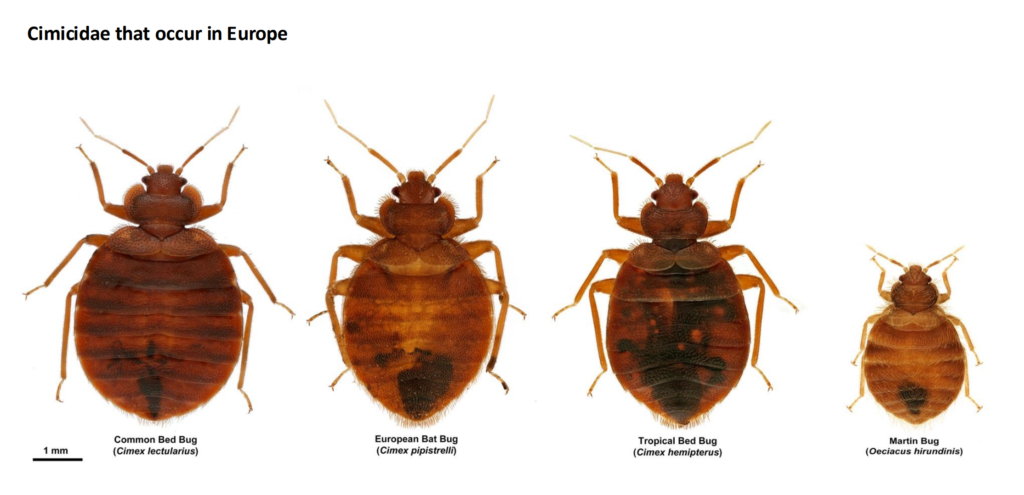
As the name suggests, it prefers warmer climates and is common across the tropics and subtropics. It is not established in the UK. It does, however, get carried around the world in luggage and belongings, and it has been reported more and more across Europe in recent years, with established populations as far north as Russia. You can see it alongside its relatives in Figure 6.
To the eye it is almost identical to the common bedbug. Separating the two reliably takes a microscope, and in awkward cases genetic testing in a lab. For a UK household the practical takeaway is simple: if you have a bedbug problem, it is overwhelmingly likely to be the common species. But it is a genuine second species, and worth knowing it exists.
The wildlife lookalikes: bat bugs and martin bugs
This is where it gets interesting, and where mistakes happen.
Two other members of the family turn up in British buildings, and both are regularly mistaken for bedbugs.
The bat bug (Cimex pipistrelli in the UK) lives in bat roosts and feeds on bats. When a roost sits in a loft or wall cavity, the bugs can wander down into the living space below, especially if the bats move on and leave them without a host.
The martin bug, sometimes called the swallow bug (Oeciacus hirundinis), lives in the mud nests of house martins and swallows under the eaves. It feeds on the birds and their chicks. When the young birds fledge and leave in late summer, the bugs are left behind, and they’ll come indoors looking for something else to feed on.
Figure 6 shows all four side by side. Up close, and with a scale to compare against, there are differences: the martin bug is noticeably smaller, and the body shapes vary a little. But loose in your home, with nothing to hold them against, you would never separate them by eye.
The martin bug’s small size is a good example of how these clues mislead. An adult martin bug is only around 3 to 4mm, which is about the size of a half-grown common bedbug nymph. So a small bug doesn’t stand out as a different species. It just looks like a young bedbug. Size, on its own, tells you almost nothing. These four insects tell completely different stories about what’s going on in your home, and yet they look almost the same.
How to actually tell them apart
There is one feature the experts use: the fine hairs along the “shoulders”, the plate just behind the head, called the pronotum.
On a common bedbug, these fringe hairs are short, shorter than the width of the insect’s eye. On bat bugs and martin bugs, the hairs are noticeably longer, longer than the eye is wide.
That’s the classic test. But two honest caveats.
You need magnification to see it. This is not something you can judge with the naked eye. It takes a good hand lens or a microscope, and a clear view of a specimen.
And even then it isn’t foolproof. Recent research has shown the hair-length method has its limits, and in awkward cases even specialists fall back on lab examination or genetic testing to be certain. So if anyone tells you they can identify a bat bug from a phone photo, be a little sceptical.
Why the difference actually matters
If it were just a naming curiosity, none of this would be worth your time. But the identification changes what you should do next.
If it’s the common bedbug, treatment focuses on the room: the bed, the furniture, the cracks and crevices where they hide and breed. This is the standard bedbug job.
If it’s a bat bug, the real source is a bat roost, and that changes everything, because in the UK, bats and their roosts are protected by law. Under the Wildlife and Countryside Act 1981 and the Conservation of Habitats and Species Regulations 2017, it is a criminal offence to deliberately disturb bats, or to damage or destroy a roost, even when no bats are present at the time. Penalties can include an unlimited fine and up to six months in prison. You cannot simply clear out a roost to solve a bat bug problem. The right step is to get proper advice, from Natural England or the Bat Conservation Trust, and handle the bugs without disturbing the protected animals.
If it’s a martin bug, the source is birds’ nests in the eaves. The bugs usually appear after the birds have left for the season. Active nests of wild birds are also protected while in use, so again, the answer isn’t to rip the nests down. It’s to deal with the bugs that have come indoors and manage the entry points at the right time of year.
Treat a bat bug like a bedbug and you’ll spray the bedroom while the real source sits untouched in the loft, and you may break the law getting near it. That’s why identification comes first.
What to do if you’re not sure
You don’t need to become an entomologist. You just need to not guess.
If you find a suspect insect, try to catch it rather than squash it. Pop it in a small clear container or stick it to a piece of clear tape so its features stay intact. Take a photo that’s as sharp and close as you can manage. Note where you found it, and whether you’ve had birds nesting under the eaves or any sign of bats in the loft. That context is often as useful as the bug itself.
Then get it looked at by someone who identifies these things for a living. Correct identification is quick, and it saves you from treating the wrong problem, or worse, disturbing wildlife you’re legally required to protect.
A small brown bug is rarely just a small brown bug. Knowing which one you’ve got is the whole game.
Some photographs courtesy of the Bed Bug Foundation.