
Most people think of bedbugs as a modern problem. A consequence of cheap travel, budget hotels, second hand furniture. Something that happens now, in cities, to unlucky people. The reality is far stranger and far older than that. Bedbugs have been with us longer than agriculture, longer than writing, longer than cities. They may have been feeding on our ancestors before we were even fully human.
Before humans, the cave connection
To understand where bedbugs came from, you have to go back to a time before houses, before beds, before civilisation. Early humans lived in caves. So did bats. And in those dark, warm, crowded spaces, something made a decision that would shape the next several hundred thousand years of human history.
Scientific research suggests that Cimex lectularius, the common bedbug, originally parasitised bats. The name itself comes from Latin. Cimex simply means bug, and lectularius means of the bed or couch, from lectulus, a small bed. Even the Romans named it for exactly where you would find it. The entire Cimicidae family, the group of insects bedbugs belong to, is thought to have evolved primarily as bat parasites. Bats were the original host. But when early humans began using caves as shelter, sharing those spaces with bat colonies, the bugs found a new and equally reliable source of warm blood.
Genetic research estimates that the bat and human lineages of Cimex lectularius diverged somewhere between 99,000 and 867,000 years ago, with the most commonly cited estimate sitting around 245,000 years ago. That means bedbugs may have been feeding on human blood since long before Homo sapiens as we know ourselves even existed. Whatever early ancestor of ours first bedded down in a cave already occupied by bats may have unknowingly started one of the longest running relationships in human history.
They’ve been with us ever since.
The first cities, the first urban pest
For hundreds of thousands of years bedbugs were simply part of cave life, an irritation shared between bats and the hominids who slept nearby. But around 13,000 years ago something changed. A 2025 whole genome study published in Biology Letters found evidence of a dramatic population explosion in the human associated bedbug lineage at roughly this point in history.
13,000 years ago is when humans began settling. When the first permanent settlements appeared and people stopped moving and started building. When population density increased and people began sleeping in the same spaces night after night, generation after generation.
Bedbugs were perfectly placed to take advantage. Unlike a parasite that needs to find a new host after each feed, bedbugs only need to travel a few feet from their hiding place to a sleeping human and back again. Dense, permanent human settlement was not a challenge for them. It was an opportunity.
This makes Cimex lectularius arguably the first true urban pest insect in human history. Not rats, not cockroaches. Bedbugs were there first.
Ancient Egypt, Greece and Rome
By the time written history begins, bedbugs were already an established and well documented nuisance.
Bedbug remains have been found fossilised at Egyptian archaeological sites dating back over 3,000 years. They were known in ancient Greece, recorded there by 400 BC, and later mentioned by Aristotle. In Egypt and Rome they were called simply Cimex, which is where the scientific name comes from. The Roman writer Pliny the Elder recorded them in AD 77, noting various folk remedies involving the bugs themselves as treatments for ailments. Whether any of those remedies worked is another matter entirely.
From Greece the bugs spread steadily across Europe as trade routes and human movement expanded. They are recorded in Germany for the first time in the 11th century, in France in the 13th century, and in England in 1583. Northampton and the wider Northamptonshire area, sitting on major trade and travel routes through the Midlands, would have seen bedbugs arrive with the same goods, furniture and travellers that carried them across the rest of the country.
By the time of the Industrial Revolution, bedbugs were endemic across Britain. In the overcrowded, poorly ventilated housing of Victorian cities they thrived. Towns like Northampton, expanding rapidly through the boot and shoe trade in the 19th century, would have had the same overcrowded terraced housing where bedbugs flourished. Every social class encountered them, from the poorest slum tenements to wealthy townhouses. The idea that bedbugs were a mark of poverty or poor housekeeping was already taking hold, but even then it was largely wrong. Bedbugs don’t care about class. They care about warmth and blood.
The brief disappearance and the return
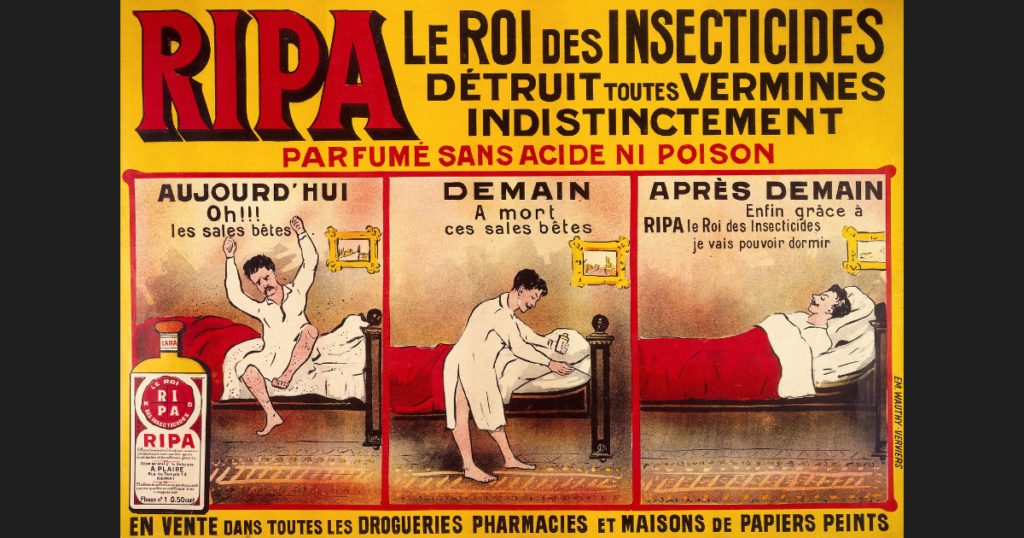
Before that, the household defence against bedbugs looked like the RIPA poster at the top of this post — patent insecticides with grand claims, perfumed sprays sold in every chemist, and a lot of hope. RIPA, “the King of Insecticides,” promised to destroy all vermin indiscriminately, perfumed, without acid or poison. Whether it actually worked is another question. This was the world DDT was about to wipe out.
The 20th century brought something bedbugs had never encountered before. DDT, developed as a pesticide during the Second World War, was spectacularly effective against them. By the 1950s bedbug infestations had become genuinely rare across much of the developed world, including the UK. For a generation or two, most people had never seen one.
It didn’t last.
From the late 1990s onwards bedbug cases began rising again, slowly at first then rapidly. The reasons are well understood. International air travel expanded dramatically, carrying bedbugs between continents in luggage at a pace that horse drawn trade routes never could. DDT was banned. The replacement insecticides, pyrethroids, were initially effective, but bedbugs have a remarkable capacity to develop resistance. Within a few decades, pyrethroid resistance had become widespread in bedbug populations across Europe and North America.
A 2025 University of Lausanne study found that 99% of human associated bedbugs sampled in western Switzerland carried knock-down insecticide resistance genes, compared to 0% in the bat associated population. The bugs feeding on bats showed no resistance at all. The resistance is ours, a product of the pesticides we have thrown at them.
Today bedbug cases in the UK are at levels not seen since before the Second World War. They are in hotels, cinemas, public transport, rental properties and family homes. They have been found in some of the most expensive hotels in London. They don’t care about the thread count.
Bedbugs in Northamptonshire today
Northamptonshire is not immune. Cases across Northampton and the wider East Midlands have followed the national trend upward, driven by the same factors affecting the rest of the country, travel, resistance, increased population density and the movement of second hand furniture and goods.
If you think you have bedbugs, the history above should reassure you of one thing. You are dealing with an insect that has been outsmarting humans for potentially a quarter of a million years. It has survived ice ages, civilisations, DDT and every home remedy Pliny the Elder ever suggested. Trying to deal with it yourself with an over the counter spray is not the answer.
Get in touch with BedBugs2Go. Use our postcode checker to see if we cover your area, or send photos through our contact form or WhatsApp for a no obligation assessment.
Bedbug specialist covering Northampton and Northamptonshire
BedBugs2Go provides fast, discreet, guaranteed bedbug treatment across Northampton, Northamptonshire and surrounding counties. It’s all we do, which means when you call us, you’re getting a service built specifically around this one insect. Not a sideline. Not an add-on to a general pest control round.